
Question: “I am looking for advice on modifications for arm movements with PICC lines and other arm devices. Are these similar to modifications for lymphedema?” The certified teacher added“I speak with each person as they join my class, but it appears one with a PICC Line does not modify the arms. I always mention to place the arms only as high was comfortable, or to rest the hands on the shoulders.”
Answered by Tari Prinster: Founder of yoga4cancer and creator of the yoga4cancer Method — developed over 20+ years of oncology-specific teacher training.
What Is a PICC Line?
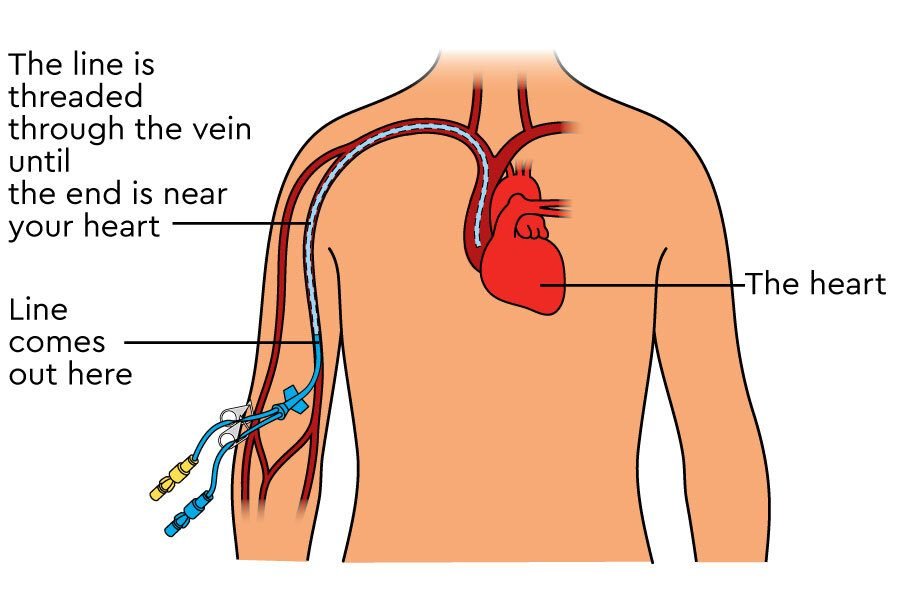
A PICC line (Peripherally Inserted Central Catheter) is a long, flexible tube inserted into a peripheral vein in the upper arm and threaded toward a large vein near the heart. It is used for long-term delivery of chemotherapy, antibiotics, IV fluids, or nutrition.
PICC lines may have one or more external lumens (ports) that remain outside the arm. They are often placed in the non-dominant arm and can remain in place for weeks or months, depending on treatment needs.
In recent decade, the use of PICC lines has increased in oncology care due to their reliability and reduced need for repeated needle sticks.
Is Exercise or Yoga Safe with a PICC Line?
Yes — movement is generally encouraged.
Clinical guidance supports gentle upper-limb movement to maintain circulation and reduce complications such as venous thrombosis or stiffness (CDC; Infusion Nurses Society Standards of Practice).
Yoga can be an excellent way to support circulation, maintain range of motion, reduce treatment-related fatigue, and improve emotional wellbeing. However, precautions matter.
General Safety Considerations for PICC Line Students
Oncology Yoga professionals should be aware of the following common recommendations:
- No swimming or submerging the arm (infection risk)
- Avoid lifting more than ~10 lbs with the PICC arm (follow medical guidance)
- Avoid repetitive, vigorous arm motions
- Avoid strong traction or pulling at the insertion site
- A securement device or sleeve may be worn to stabilize the line during activity
- Avoid direct pressure on the catheter site (e.g., in prone weight-bearing poses)
Additionally, monitor for signs of redness, swelling, warmth, pain, or shortness of breath (possible clot or infection — refer immediately to medical care), and be cautious with strong weight-bearing through the PICC arm (e.g., full Plank, Chaturanga).
Sample Pose Modifications for PICC line Students
| Pose / transition | Why the pose could be a concern for a PICC line | yoga4cancer Method modification |
|---|---|---|
| Vinyasa jump-backs (Plank → Chaturanga → Up Dog → Down Dog) | Vigorous, full-weight transition through the arms | Not used in the yoga4cancer Method. Replace with the Step-Back Transition using block towers, chair or similar, and in Sun Salutations use the Modified Sun Salutation: Stand Tall (Mountain), Chair Pose, Step-Back to Lunge (from standing), Step-Up to Chair (from hands and knees) |
| Plank | Full weight through both wrists/shoulders | From hands and knees, extend one leg back with the other knee down — keeps alignment, breath, and strength stimulus with less load on the PICC arm; option to bring forearms to blocks for added wrist support |
| Downward Facing Dog | Half-inversion loads both wrists/shoulders and can pressurize the insertion site | Already avoided as a transition in the Method. Use Step-Up/Step-Back with hands on blocks, Puppy Pose (knees down, head on a block), or the wall/chair variation (torso no lower than a right angle at the hips) |
| Hands-and-knees work (Table Top, Cat/Cow) | Sustained wrist/forearm loading | Reduce time spent on hands and knees; stack blocks under forearms/wrists/hands to redistribute load off the PICC arm |
| Overhead reaches (Sun Salutation arms, Warrior I) | Sustained overhead extension through the PICC arm | Reach only as high as comfortable; option to rest the PICC-side hand on the shoulder instead of extending overhead — this is exactly the cue the certified teacher in this question is already using |
Always defer to the student’s medical team and comfort level over any general guideline.
Is This Similar to Lymphedema Modifications?
There are similarities — but for different reasons.
With lymphedema, precautions aim to protect a compromised lymphatic system and prevent swelling exacerbation. [See our related piece: Yoga and Breast Lymphedema: What Teachers and Survivors Need to Know.]
With a PICC line, precautions aim to prevent catheter displacement, avoid irritation or infection, and reduce mechanical stress at the insertion site.
For both conditions, Oncology Yoga emphasizes gentle, cycled arm movements, gradual load progression, non-forceful transitions, and intentional breath-synchronized movement. But the underlying physiology differs.
Overhead Movements — Are They Allowed?
Overhead movement is not automatically contraindicated with a PICC line.
If a student is limiting movement purely out of fear of disrupting the line, gentle overhead mobility — when medically cleared — can support circulation and prevent stiffness. [This is the same principle behind why we teach Downward Facing Dog safely rather than eliminating it outright — see Ask Tari: Why Doesn’t Yoga4cancer Include Downward Facing Dog?]
However: avoid sudden, ballistic movements, avoid long-duration weight-bearing through that arm, and observe carefully.
If range of motion is restricted, the limitation may stem from surgical scarring, radiation fibrosis, lymphedema, general deconditioning, or a fear or misunderstanding of PICC line & movement recommendations.
This is why your Fast Facts intake process is critical. Identify the true source of limitation before modifying unnecessarily.
How the yoga4cancer Method Supports Safety
The yoga4cancer Method is inherently aligned with PICC precautions because it uses controlled, breath-led movement, emphasizes gradual load, incorporates props to reduce full weight-bearing, encourages awareness over force, and avoids high-intensity repetition.
The goal is not immobilization — it is intelligent movement.
This kind of case-by-case clinical judgment is exactly what’s covered in depth in our 75-Hour Oncology Yoga Certificate Program — general yoga training doesn’t include it.
Final Thought
A PICC line is not a reason to stop practicing yoga. It is a reason to practice wisely.
As Oncology Yoga professionals, our role is not to restrict movement unnecessarily — but to understand risk, ask informed questions, and guide safe adaptation. When we teach with knowledge, we reduce fear. When we reduce fear, we restore function.
Have a question for Ask Tari? Submit it here and it may be featured in a future post. Looking for a certified oncology yoga teacher near you or online? Find a Teacher.
References
- Centers for Disease Control and Prevention (CDC). Guidelines for the Prevention of Intravascular Catheter-Related Infections.
- Infusion Nurses Society (INS). Infusion Therapy Standards of Practice.
- Chopra V. et al., (2013). The Michigan Appropriateness Guide for Intravenous Catheters (MAGIC).
- National Comprehensive Cancer Network (NCCN) Survivorship Guidelines.
Explore Oncology Yoga Classes, Courses and Research


Find a y4c trained teacher near you at yoga4cancer.com/find-a-teacher, or explore the full Beginners Series.