Every week, people living with cancer — and the healthcare professionals who support them — go looking for specialized yoga instruction. They open a browser, enter a city or a language, sometimes a specific name a friend gave them, and they land on the yoga4cancer Find-a-Teacher directory.

We recently analyzed nearly 7,700 of those searches. The data tells a clear story about where oncology yoga is being sought, how people are looking for it, and what it means when a qualified teacher isn’t there to be found.
Whether you are a yoga teacher considering oncology yoga teacher certification, or a healthcare institution evaluating integrative oncology programming, the numbers are worth understanding.
Global demand for oncology yoga teachers is documented and growing
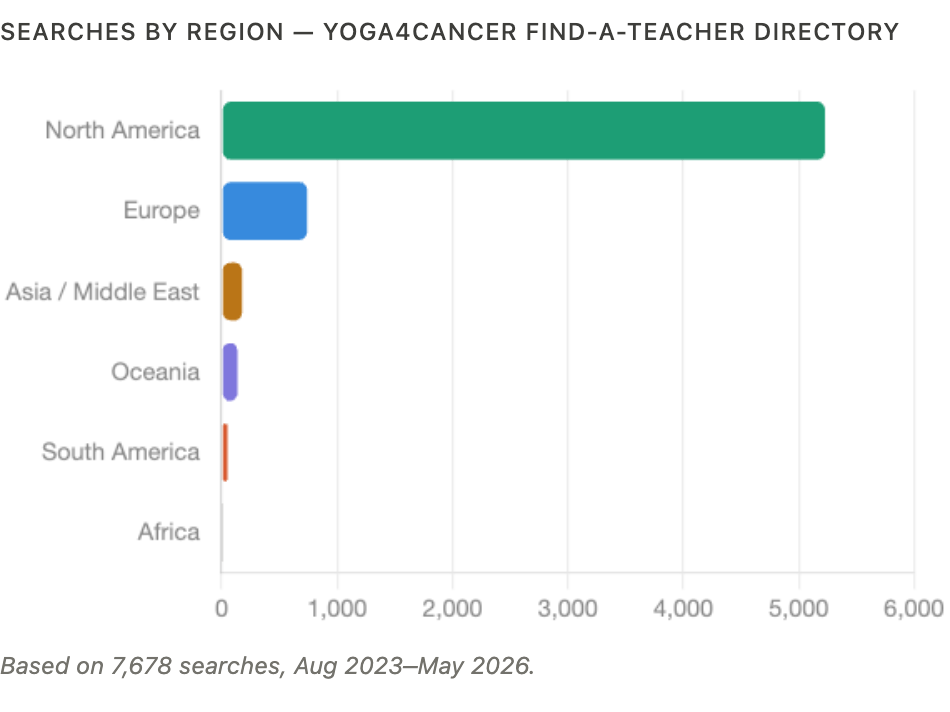
Searches came in from 39+ countries across six continents.
- North America accounts for the majority — more than 5,200 searches — with the United States alone generating 4,888.
- Europe contributed 740, followed by Asia and the Middle East at 177, Oceania at 135, and South America at 51.
This isn’t aspirational data. These are real people, on their phones and laptops, actively looking for a yoga teacher with oncology-specific training. The demand exists independently of the supply — and in many regions, supply has not yet caught up.
The US: coast to coast demand, led by major metros
Within the United States, searches came from every region of the country. California and New York lead by volume — 574 and 541 searches respectively — followed by Florida (325), Texas (294), Massachusetts (211), Pennsylvania (209), and New Jersey (203).
At the city level, New York City dominates with 191 searches, followed by Seattle (56), Los Angeles (55), Brooklyn (46), Minneapolis (45), Chicago and Austin (41 each), San Diego (41), and Charlotte (39). Houston, Denver, Pittsburgh, Portland, Dallas, Washington DC, and Boston all appear in the top twenty.
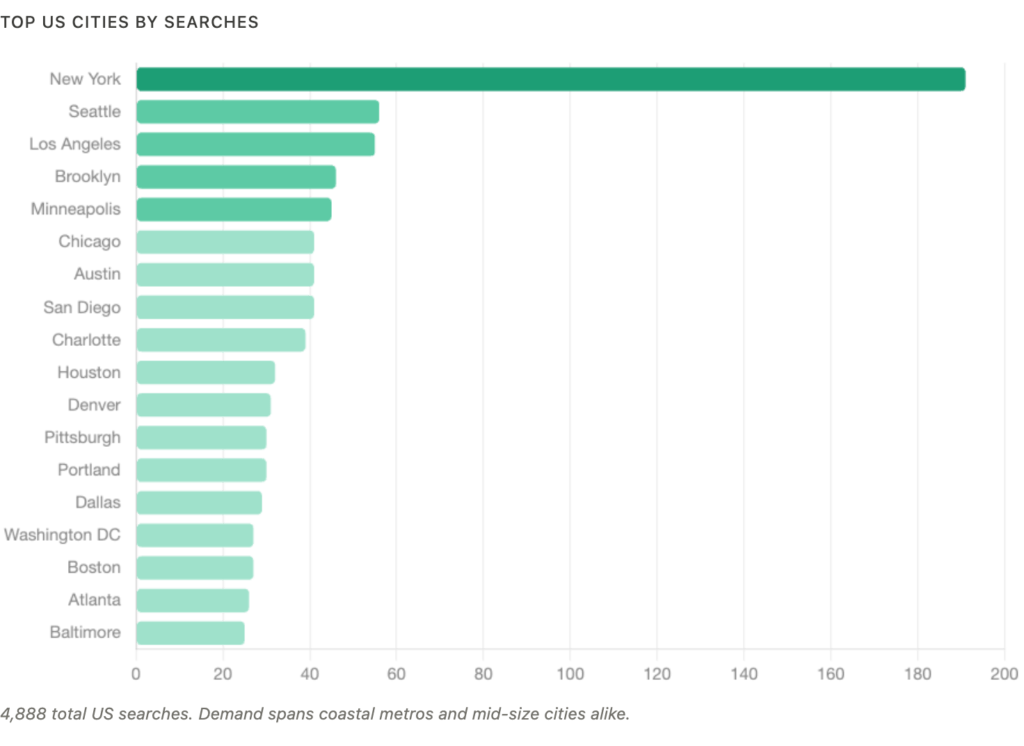
The geographic spread matters. This is not a coastal or urban-only phenomenon. Charlotte, Minneapolis, Pittsburgh, Austin, and Denver generating significant search volume points to demand in mid-size metros that are often underserved by specialized wellness providers. For a certified teacher in any of these cities, the directory is an active referral channel — not a passive listing.
Searches reveal two types of intent: discovery and referral
The majority of directory searches (83%) are location-based. People are looking for an oncology yoga teacher near them, or one who offers online sessions. That’s the discovery use case: someone newly diagnosed, recently finished treatment, or supporting a loved one who wants to know what’s available in their area.
But nearly one in five searches — 19% — are by name or email address. In the US data, specific teacher names appear searched repeatedly: four or more times each, from different devices, over time. Someone told them about a specific teacher. They were referred.
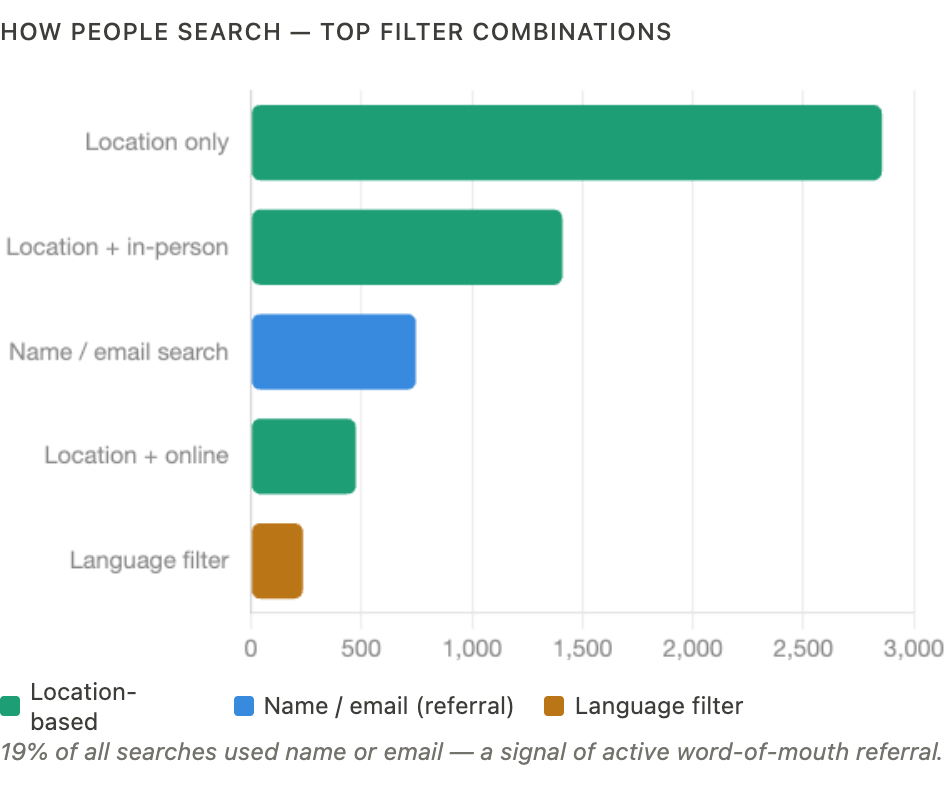
That pattern shows up in the data in a way that doesn’t always surface in marketing conversations: word-of-mouth referrals are generating real, trackable directory traffic. For certified oncology yoga teachers, visibility in the directory is not a passive benefit. Referrals you didn’t know were happening may already be directing people to your profile.
Most people searching haven’t decided how they want to work with a teacher yet
More than half of all directory searches express no delivery preference — no filter for in-person or online. People are browsing to see what exists before making decisions. They are not yet committed to a format; they are in discovery mode.
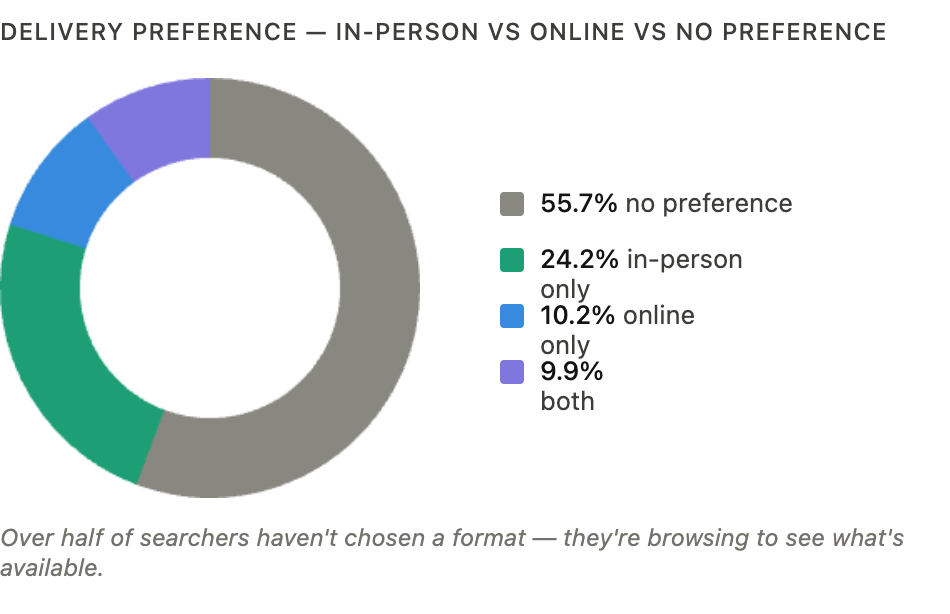
Among those who do specify a preference, in-person is the clear first choice. But online demand is consistent and meaningful, particularly in countries where certified teachers remain sparse. In states like Idaho, Maryland, Georgia, and Washington, online preference rates run notably higher than the national average, suggesting that searchers there are open to virtual instruction when local options are limited.
A strong directory profile that clearly describes what you offer — in-person, online, or both — is what converts a curious search into an inquiry. The search is already there. The profile is what determines whether it reaches you.
North America’s broader picture: Canada is your second-largest market
Canada contributes 288 searches, making it the second-largest national market in the directory after the United States. Ontario leads (141 searches), followed by British Columbia and Quebec. At the city level, Kitchener (32), Toronto (28), Montreal (13), and North Vancouver (11) are the strongest Canadian markets.
For teachers based in Canada, or US-based teachers offering online instruction, this represents a documented, cross-border audience that is actively searching.
International demand: where the gaps are largest
Beyond North America, Europe (740 searches), Asia and the Middle East (177), and Oceania (135) all show consistent demand. The UK is the strongest single international market with 407 searches, followed by Germany, Italy, and Spain. In Asia, India generates 111 searches — the highest of any non-English-speaking country — with Japan at 19 and Malaysia at 10.
Language filtering is used by 12% of all searchers globally. Spanish, Hindi, French, Italian, German, and Dutch speakers are all represented. For teachers who instruct in a language other than English, that capability is often the primary filter that determines whether they appear in results at all.
European searchers skew mobile and are looking beyond major cities
European searches span 24 countries and more than a dozen major cities. London generates the most traffic, but Manchester, Cambridge, Edinburgh, Madrid, Stockholm, Berlin, Geneva, Paris, Amsterdam, and Milan all appear in the data. Demand is not concentrated in capitals — it is distributed across communities where cancer patients live.
Notably, 61% of European searches come from mobile devices, compared to 49% globally. Directory profiles, linked websites, and any teacher-facing digital presence need to function clearly on a small screen. That is where first impressions are formed.
Non-English speakers are actively searching — and filtering by language
The directory’s language filter is used by 12% of all searchers. When they do use it, most want English — but Spanish, Hindi, French, Italian, German, and Dutch speakers are all represented, along with searches filtering for Russian, Polish, Catalan, and Chinese from European locations.
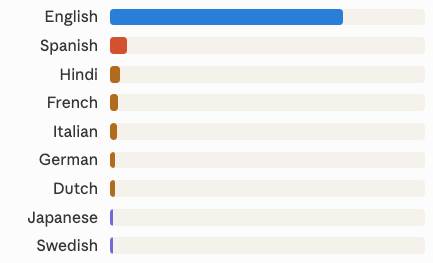
If you teach in a language other than English, that capability is not a secondary credential. For a portion of searchers, it is the primary filter that determines whether you appear in results at all.
What this means for yoga teachers considering oncology yoga certification
The yoga4cancer directory is a live, actively searched professional tool. When you complete your y4c oncology yoga certification, you are listed in that directory immediately — findable by cancer survivors, caregivers, and healthcare professionals in your city, country, and language community.
yoga4cancer has trained more than 3,000 oncology yoga professionals across 39+ countries. The certification program covers the biology of cancer and its treatments, evidence-informed yoga modifications for treatment side effects, clinical communication skills, and the practical foundations of building a sustainable oncology yoga practice. It is the only oncology yoga certification program of its scale and depth, with Yoga Alliance YACEP status and institutional placements that include Memorial Sloan Kettering Cancer Center.
The searches documented here are not projected demand. They represent real people who went looking for what you will be trained to offer.
What this means for healthcare institutions and integrative oncology programs
If you are a cancer center, integrative health program, hospital wellness department, or community health organization, the directory data addresses a practical question: is there qualified oncology yoga support available in our region, and how do we connect with it?
In many cases, the answer is yes — and the gap is one of connection rather than capacity. yoga4cancer-certified teachers are trained specifically in cancer biology, treatment side effects, contraindications, and safe evidence-informed practice. Many are already working within clinical and community settings. The y4c directory makes that connection possible; the certification program makes it reliable.
For institutions seeking to formalize an oncology yoga offering, yoga4cancer can provide program support, institutional resources, and access to the largest certified oncology yoga teacher community in the world.
yoga4cancer has trained more than 3,000 oncology yoga professionals across 39+ countries. To explore the certification program, visit here. To find a certified teacher, visit yoga4cancer.com/find-a-teacher.