
Many well-intended professionals expect to be provided a tidy list of approved poses for cancer patients and survivors as part of an Oncology Yoga training. In a world obsessed with ‘Top Ten’ headlines, thats’s understandable. But, the concept itself misses the point.
Oncology Yoga can’t be reduced to a pose checklist. A cancer patient’s needs vary dramatically – based on diagnosis, treatment history, existing physical condition and dozen of other factors that have nothing to do with the cancer itself. Our pedological approach is built around something harder and more valuable than a list: the ability to look at the person in front of you, think critically about what is needed and deliver a safe & effective practice to support that individual’s needs.
We develop this skill through three core concepts.
1. Progressive Learning
We teach professionals how to think, not just what to remember. In our Certificate Program, that means students build a solid grounding in the theory and science of both yoga and cancer — the why and the how — before moving to the what of Oncology Yoga practice. That sequence isn’t arbitrary. A strong intuitive foundation can’t be shortcut.
2. The Socratic Method
Critical thinking doesn’t develop from lectures, reading or lessons alone. It develops from being questioned, challenged, and asked to reason through complexity. We use several approaches to build this:
- Thoughtful questions: Some straightforward, some deliberately provocative, some based on material that students haven’t encountered yet. All designed to stretch the student’s thinking.
- Different perspectives: We often challenge pre-existing concepts of both yoga and cancer. That tension is intentional. It’s how bias gets identified and better conclusions get formed.
- Evidence over opinion – We ask people to evaluate evidence or research, not just accept received wisdom or opinions. Understanding what evidence actually shows — and where gaps exist — is fundamental to Oncology Yoga practice.
- Sitting with uncertainty – A critical thinker can say “I don’t know” or “I need more information.” Real clinical situations are rarely black-and-white.
- Reflection – We encourage self reflection so that evaluating your own thoughts or process becomes second nature.
- Problem-Solving & Scenario Testing – concepts get tested through practical application, not just comprehension checks.
3. Bloom’s Taxonomy
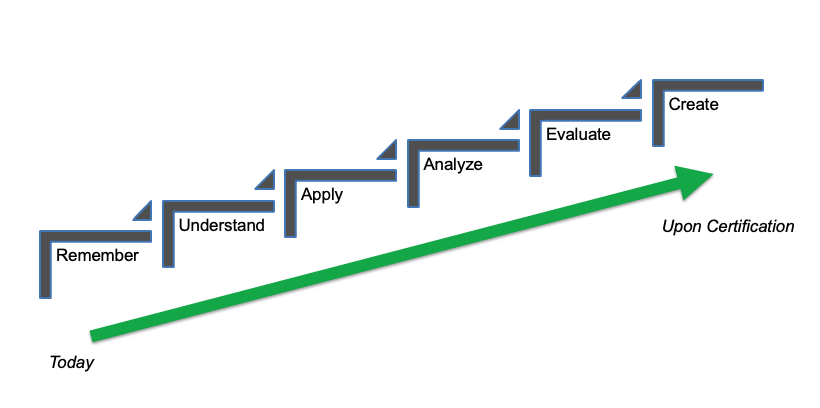
We’ve structured our certificate program using Bloom’s Taxonomy — a hierarchical framework for cognitive skill development — to ensure that learning doesn’t stop at recognition or recall. Teaching approaches vary throughout: sometimes forecasting concepts before you have the full context, sometimes revisiting past material in a new way. The goal in both cases is the same — retention, comprehension, and the ability to execute.
Because ultimately, none of this is academic. It’s about being genuinely prepared for the person who walks through your door and trusting what you know to help them.
If this approach resonates with you, we’d love to have you in the course or program. The 5-Hour Course is a low-commitment way to experience it firsthand — and the 75-Hour Certificate Program is where the deep work happens.
👉 Explore your options