There is a well-meaning assumption that follows people through a cancer diagnosis: that what they want most from yoga is to relax. To lie down, breathe, and be left alone. Stress relief and rest are positioned as the whole point, and gentle, restorative yoga becomes the default — sometimes the only version of yoga survivors are ever offered.
Rest is genuinely valuable. But this assumption gets something important wrong. Survivors are not only managing stress. They are managing fatigue, muscle loss, bone density decline, neuropathy, lymphedema risk, balance problems, and the slow loss of physical confidence that can come with treatment. Relaxation alone does not address most of that. Purposeful movement can.
What we mean by “gentle” and “active”
These words mean different things to different people, so it’s worth being precise.
Gentle, as we use it here, means passive. On most studio schedules, “gentle” or “restorative” yoga describes a class where props support the body, poses are held at rest, and the muscles do very little work. That kind of practice has real value for rest, sleep, and stress relief.
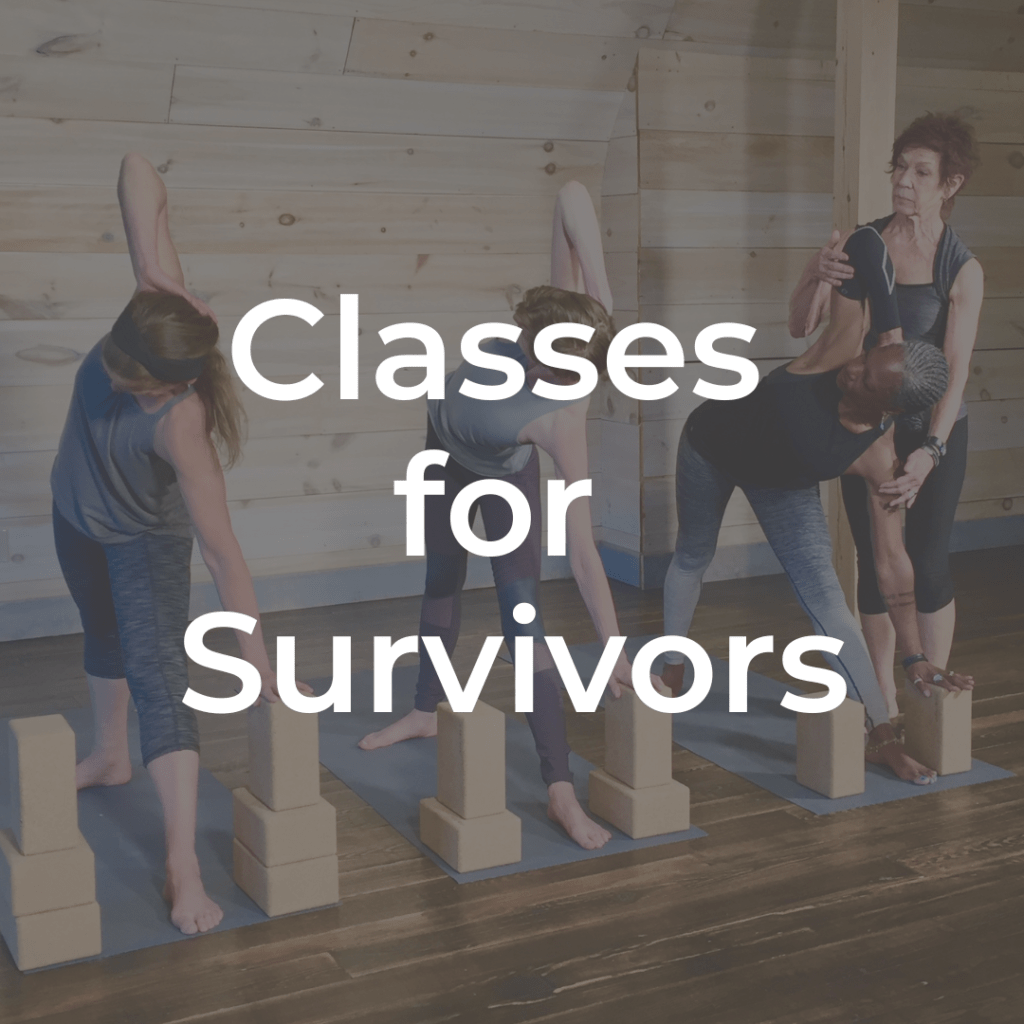
Active does not mean intense. It does not mean power yoga, hot yoga, fast-paced vinyasa, or pushing through pain or exhaustion. In Oncology Yoga, active means the body is doing purposeful work: bearing weight, building strength, challenging balance, and moving joints through their available range.
Active practice can be slow. It can happen in a chair or against a wall. It can be fully modified for a port, neuropathy, lymphedema risk, or a low-energy day. What makes it active is that muscles and bones are asked to work, at a level that fits the person, and that the work builds gradually over time.
The myth we need to retire
Within Oncology Yoga training, we name this directly: the belief that stress and relaxation are a survivor’s greatest concern, and that yoga for this population should therefore always be gentle and restorative, is a myth.
The fact is that active practice benefits survivors — supporting the immune system, strengthening bones, rebuilding function, and providing a real sense of empowerment. An evidence-informed Oncology Yoga practice holds both active and restorative work, not one to the exclusion of the other.
Defaulting every survivor to the gentlest possible practice isn’t caution. It’s a missed opportunity, and often it isn’t what the person in front of you actually needs.
Beyond Gentle Practice — Why Efficacy Matters in Cancer Recovery
You may have been guided toward the gentlest, most restorative version of yoga out of caution, and rest is genuinely valuable. But staying only in that territory can quietly limit what yoga can actually do for you. When a practice is too cautious to create real change, the body isn’t getting what it needs to rebuild strength, restore function, and reduce the side effects that affect daily life.
Your body is capable of more than gentle practice. Feeling this truth within your body is empowering and improves recovery. You deserve to gain more from yoga than comfort and rest alone.
Safety makes your practice possible. Efficacy makes it worthwhile.
This is true regardless of where you are in your cancer experience. Whether you are in active treatment, early recovery, living with metastatic disease, or years beyond your last appointment, the principle is the same. The pace, the intensity, and the approach will differ from day to day. But the imperative to move, and to move with purpose, applies across every stage. Oncology Yoga is designed to be flexible to meet you where you are and build from there.
What the guidelines say
The American Cancer Society, the American College of Sports Medicine, and the American Society of Clinical Oncology (ASCO) are now unambiguou: cancer survivors should not avoid movement. They should pursue it progressively and consistently, working toward 150–300 minutes of moderate movement per week, alongside muscle-strengthening activity at least twice a week. The starting point is wherever you are, moving slowly and building over time.
Research shows that even 90 minutes of moderate movement per week — three 30-minute sessions, or six 15-minute sessions — produces meaningful improvements in the most common and disruptive treatment side effects.
ASCO’s own integrative oncology guidelines, developed with the Society for Integrative Oncology, recommend yoga specifically for managing cancer-related fatigue — built on evidence from programs using gentle, restorative sequences. That a gentle yoga program already shows measurable benefit is the floor, not the ceiling: if modest practice moves the needle, a more active, individually paced Oncology Yoga practice should do more.
The goal is to keep moving in a way that builds over time.
What a consistent practice can do
A well-designed and regular Oncology Yoga practice has documented benefits across thousands of cancer patients and survivors in clinical research:
- Reduced cancer-related fatigue
- Improved sleep quality
- Reduced anxiety and low mood
- Rebuilt strength and supported bone health
- Improved balance and reduced fall risk
- Better lymphatic flow and circulation
- Improved overall quality of life during and after treatment
Recovery is active
There is a meaningful difference between managing symptoms and actively participating in your own recovery. Oncology Yoga is designed for the second.
Every time you show up for your practice, however you feel, that is active recovery. Research shows it improves not just physical outcomes but your sense of agency over your own body and your own experience.
You are not a passive recipient of care. You are an active participant in your recovery.
Why this matters for how we teach
The data on what survivors are actually doing tells its own story. The overwhelming majority of cancer survivors do not meet basic physical activity guidelines, and only a small fraction meet both aerobic and strength-training recommendations. That gap isn’t because survivors don’t care about their recovery. It’s because so much of what’s offered to them — in yoga rooms and beyond — has been shaped by an assumption that they’re too fragile for anything more than stillness.
Every Oncology Yoga teacher carries some responsibility for that gap. When we default to gentle because it feels safest to offer, we may be protecting ourselves from risk more than we’re serving the person on the mat. Safety and efficacy are not in competition. An Oncology Yoga practice trained in both can offer real strength work, real balance training, real muscular effort — modified, sequenced, and paced correctly for where that student is that day.
Gentle yoga has its place. So does rest. But neither should be the ceiling. Survivors deserve a practice built to move them forward, not just to hold them still.
Sources:
- Ligibel, J.A., Bohlke, K., May, A.M., et al. (2022). Exercise, Diet, and Weight Management During Cancer Treatment: ASCO Guideline. Journal of Clinical Oncology, 40(22), 2491–2507. https://ascopubs.org/doi/10.1200/JCO.22.00687
- ASCO–Society for Integrative Oncology Guideline Update (2024). Management of Fatigue in Adult Survivors of Cancer. Journal of Clinical Oncology. https://pubmed.ncbi.nlm.nih.gov/38754041/
- Rock, C.L., Thomson, C.A., Sullivan, K.R., et al. (2022). American Cancer Society Nutrition and Physical Activity Guideline for Cancer Survivors. CA: A Cancer Journal for Clinicians, 72(3), 230–262. https://acsjournals.onlinelibrary.wiley.com/doi/10.3322/caac.21719
- U.S. Department of Health and Human Services. (2018). Physical Activity Guidelines for Americans, 2nd edition. Washington, DC.
Explore Oncology Yoga Classes, Courses and Research