IRB-Approved Pilot and Feasibility Study — Hartford HealthCare Cancer Institute

Establishing Yoga4Cancer (Y4C) as the Hospital-Based Standard for Oncology Yoga

Why This Study Matters

Yoga is increasingly offered in cancer care settings — but not all yoga is created equal. When hospitals offer classes from practitioners with varied training, it creates real challenges: patients, families, and clinicians struggle to identify safe, effective programs. This study asked a direct question: Can yoga4cancer (Y4C) become the evidence-based standard for oncology yoga in a hospital setting?

In partnership with the Hartford HealthCare Cancer Institute at Hartford Hospital's Department of Integrative Medicine, yoga4cancers founder Tari Prinster collaborated on a pilot and feasibility study to find out.

Study Objectives
  1. Train yoga providers in the yoga4cacner oncology-specific method
  2. Develop an IRB-approved protocol with quality-of-life (QOL) and functional yoga outcomes
  3. Recruit cancer patients into a structured, hospital-based yoga4cancer program

Methods

All yoga practitioners completed CITI research training. The Y4C class protocol was structured as one 60-minute class per week for 8 weeks, with a follow-up session at week 12.

Outcome measures included:

  • Edmonton Symptom Assessment Scale
  • EORTC QLQ-C30 (Version 3) quality-of-life questionnaire
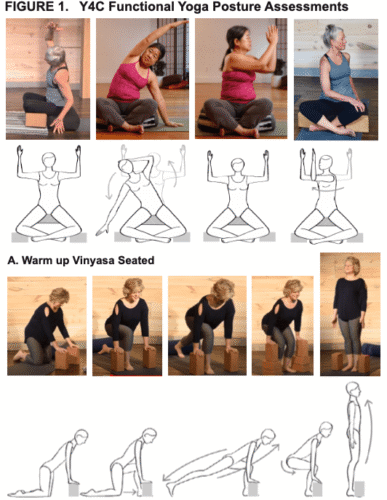
  • Five Y4C functional performance poses, rated on a 10-point Likert scale (0 = cannot perform; 10 = easy to perform)

Inclusion criteria: Cancer patients at any stage (early diagnosis, active treatment, or survivorship), age 18+, physician approval

Exclusion criteria: Significant comorbidity, musculoskeletal injury, fragility, balance disorders, or vertigo without physician clearance


Results

75% of enrolled participants completed all 120 Y4C sessions over the initial 4-week assessment period.

Participant demographics:

  • 84% female, 16% male
  • Average age: 61 years
  • 72% Caucasian, 12% African American, 10% Asian
  • Most common diagnosis: breast cancer (72%), followed by prostate and ovarian

Quality-of-Life Improvements (Week 1 → Week 4):

SymptomWeek 1Week 4p-value
Sleep Trouble2.21.90.039
Feelings of Depression1.20.620.027
Nausea1.11.30.031
Do You Worry1.91.60.09
Feeling of Wellbeing2.82.20.09

Functional Pose Improvements (Week 1 → Week 4):

Y4C PoseWk 1Wk 4% Change
Warm-Up Vinyasa Seated7.07.4+4.3%
Getting to Hands & Knees6.77.4+9.1%
Kick-Stand Tree6.56.3-1.5%
Chair & Block Test6.47.1+10.9%
Forward Fold6.47.0+9.4%
 

Conclusions

This pilot study demonstrated:

  • Feasibility: An IRB-approved, hospital-based Y4C program with trained oncology yoga therapists is achievable
  • Measurability: Functional yoga performance and quality-of-life outcomes can be tracked and assessed over time
  • Preliminary efficacy: Meaningful early improvements in sleep, depression, and physical function within just 4 weeks

Originally presented at the Society for Integrative Oncology (SIO) 16th Annual Conference: Advancing the Science & Art of Integrative Oncology, 2019 — sponsored by Memorial Sloan Kettering Cancer Center.